Not just Mont Saint-Michel: Normandy between art, history and memory
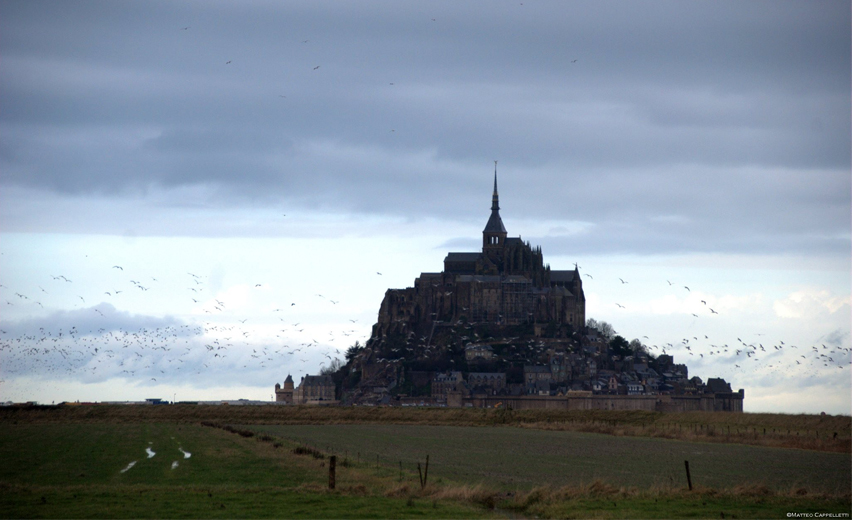
Mont Saint-Michel is for Normandy what Tour Eiffel is for Paris, the Big Ben for London or Coliseum for Rome. An iconographic symbol, a distinguishing feature, a postcard that identifies the region in the world. It could not be otherwise. The Benedictine abbey, which stands on a rocky edge connected or isolated from the mainland by tides, has been included in UNESCO’s World Heritage Site since 1979. Its heady beauty and the fame resulting therefrom, attract thousands of visitors every day, making it a must for their, sometimes hurried, travels in northern France.
Nevertheless, identifying Normandy with Mont Saint-Michel is not only unfair, but also wrong by a geographical point of view: in fact, the Mont is located right on the western edge of the region, on the border with the wild Britain. Moving towards the east limit over Dieppe, through a pleasant countryside dotted with charming towns (avoid highways and choose back roads through the fields!), you can discover the many faces of a magical region that has so much to offer, from many points of view.$

The cradle of Impressionism
Normandy, especially in the area of Upper Normandy – that from Rouen along the Seine valley goes up to the cliffs of the Côte d’Alabaster and the seaside resorts of the Côte Fleurie – has been a source of inspiration for many exponents of impressionist art. It is not so dared to say that, without the colors, the scenery and the light of this land, we would not have been able to appreciate the works of the great Impressionists of the late nineteenth century. It is no coincidence that Monet has spent here most of his artistic life, transferring to the canvas the magic of Rouen Cathedral (at all hours of the day), the wonder of the white cliffs of Étretat eroded by the wind or the charm of port of Honfleur. If you visit his home in Giverny, it is possible to feel like walking into a painting of the cycle “the Water Lilies”. The same places and atmospheres also fascinated Renoir, Pissarro, Gauguin, Degas, Delacroix. In another century, also Jean Claude Duteil and François Gall, protagonist of the upcoming exhibition of Artrust, found in these places inspiration for some of their works.
Discover Normandy over these famous artists’ footsteps is just one option you have to visit this wonderful place.
You can find itineraries visiting www.normandie-tourisme.fr
The remembrance beaches
6th June 1944: D-Day. The wide sandy beaches of Normandy became the scene of one of the bloodiest battles in history. The Allied landing on the costs of Normandy means for Europe the beginning of the Second World War’s end, an awakening after the Nazi darkness. However, for Normandy, it was instead a dramatic injury, with indelible marks.
Walking through the main sites of clashes between Allied and German – in Caen, Arromanches, Longue-sur-mer, Colleville-sur-mer, Point-du-Hoc, Sainte-Mère-Église – you feel like time has stopped, as in a suspended atmosphere. Guns, artillery, jetties, military means. Everything is still in its place still: a warning to not forget and evidence of an inability to go on at the same time.
There is no better way to understand the dimensions of the dramatic events that visiting the many military cemeteries scattered along the coast: among all, the American Military Cemetery at Colleville-sur-mer and the German cemetery at La Cambe, if only to appreciate the chromatic contrast between the white marble tombstones of “the good ones” and the gloomy tombs of the “bad ones” (provided that these categories could be used in an historical way).
Today, the landing places are visited by a growing tourism, which reached its peak this year on the 70th anniversary of the Battle.
For further info: www.memorial-caen.fr
Medieval and Gothic traces
The connection between Normandy and the story is not limited to the most recent events of World War II. These lands saw William the Conqueror becoming King of England, and the sacrifice of Joan of Arc, who was crucial in reviving the fortunes of French during the Hundred Years War.
The ancient and mysterious medieval past still hovers in the region. It is present in the historic centers of cities, perfectly preserved, with their picturesque timbered houses. you can breathe along the towering aisles of the imposing Gothic abbeys: Abbaye-aux-Hommes in Caen, Notre-Dame de l’Assomption in Rouen (Monet cathedral), Notre-Dame in Bayeux, and many others, without forgetting the most famous one Abbaye de Mont-Saint-Michel.
You can see it in the over 68 meters of linen canvas of Bayeux tapestry (added in 2007 in the list of UNESCO’s Memory of the World) which describes images for the Norman conquest of England in 1066.
You can finally live in the many castles and fortifications still present, now transformed into luxurious hotels: stay there, if only for one night, you will return the real emotions of a distant but still tangible past.
For further info: www.bienvenueauchateau.com
Travel tips
A trip to Normandy, without losing anything of its many attractions, has to be made “on the road”. Renting a car and enjoy driving along scenic roads, well-marked and little traffic, is the best solution to best appreciate the scenery and nature. The selection of accommodation is wide and varied: from the luxurious castles and stately homes, to the most extreme and unusual ones, like sleeping in a lighthouse, are just few possible solutions. To fully experience Normandy, however, our advice is to stay in one of the different chambres d’hôtes of “Gîtes de France”, spread over the territory: familiy b&b, in rural settings, well-finished from an aesthetic point of view, allow you to get in touch with the friendly local people and (if you understand French) to have a good chat at breakfast with crispy baguette, homemade jams and freshly cooked crêpes.
For further info: www.gites-de-france.com