Visit the Langhe, between wine and art
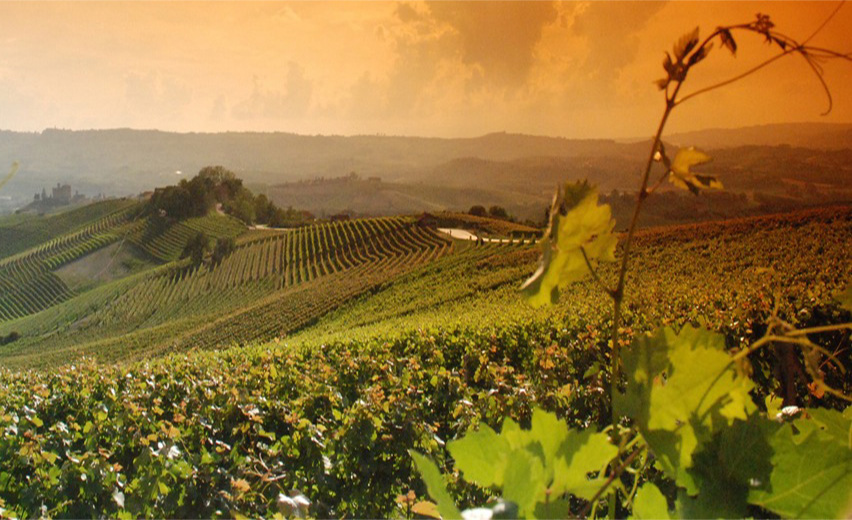
September is the perfect month to spend some time near Alba experiencing the charm of the grape harvest in the Langhe, the rolling hills of south Piedmont known for its art, fine wines, that recently became a World Heritage Site.
An inspiring tapestry
In Arvi’s cellars there is a fine tapestry dating from XVII century. The fabric describes an idyllic scene of mythological nature: in fact, the view opens onto a park where satyrs and putti are dancing and playing. There is also space for a portrait of a Bacchus riding a goat, while in the background a royal palace stands (most likely a French château). In the festive representation by Charles Le Brun, author of the work and also great painter and decorator from sixteenth century at the service of Louis XIV, it can be recognized by analogy an area as much as wonderful: the Langhe in Italy.
In the surrounding of Alba, in the heart of the Langhe
The Langhe, located in the southern part of Piedmont, is famous throughout the world for producing some of the greatest Italian wines such as Nebbiolo, Barbera and Barolo. The hills surrounding Alba, historical and economic capital of this “region in the region”, are gems lined with vineyard which preserving wine treasure but not only; the beauty of the landscape merges with centuries of history and art: castles, monuments, monasteries and museums reveal the splendor of the cultures that have passed by here. Natural and man-made attractions guaranteed to the Langhe a place in the Unesco list as a World Heritage Site, a proper recognition that has galvanized the local eno-gastronomic and cultural tourism.
Visiting the Langhe
To fully appreciate all the aspects that make the Langhe unique, September is probably the ideal month. This is the time of the year when the harvest begins, the most fascinating and important moment for these lands that have always been dedicated to wine. There are several opportunities for a charming stay in historical renovated residences.
In Cherasco, for example, there is a monastery dating back to the Seventeenth century and home of the College of Somascan Fathers since the mid Nineteenth century. The immense palace, now Somaschi Hotel http://monasterocherasco.it/ , has been restored to its former glory after a careful restoration that preserved the common rooms with original stucco plaster of the eighteenth century, the lounges with 7 meter high ceilings and original frescoes, the majestic parade staircase and the luxurious hall of the theater with an antique stage set original from 1700.
Near Santo Stefano Belbo the monastery of San Maurizio http://www.relaissanmaurizio.it/it/ rises up, founded in 1619 by Cistercian monks, who lived there until 1802. The monks, coming from Provence, introduced vine cultivation and wine production in this area. In 1997, the building was restored as a luxury hotel. The Relais now offers 30 rooms and suites, each different from the others in form, style and decor. The accommodations were obtained from the distribution of the old convent’s spaces, which remained unchanged. All common spaces (including a living room with original frescoes) and the main building’s rooms have a great view on a picturesque inner cloister.
The Castle of Sinio http://www.hotelcastellodisinio.com/ closes this brief review. Situated in the south of Alba and dating back to 1142, the castle, one of the oldest of the Langhe area, keeps furniture and paintings dating back to over 600 years ago: a real time travel!
What to visit nearby – Routes starting from Alba
In 15 minutes, you reach Barolo and its Museo dei Cavatappi (Corkscrew Museum), http://www.museodeicavatappi.it/ which preserves 500 pieces of antique corkscrews from all over the world and made from the second half of 1600.
In 20 minutes, you reach the Castle of Govone, which has medieval origin and was then transformed into a noble villa and becoming a residence for the thinker Jean Jacques Rousseau and the King of Sardinia, Carlo Felice of Savoy. The building is now part of the 8 “castles doc”, the circuit of the castles between the Langhe and Roero.
In Lurisia (1 hour away from Alba), you can have some relax at the renowned SPA, famous for its mud treatments, inhalations and balneotherapy.